We work to advance the practice of teaching cybersecurity through curriculum development and strengthening the profession and practice of teaching cybersecurity.
Curriculum Guidelines - HSCCG
The High School Cybersecurity Curriculum Guidelines outline the subjects that should be covered in high school cybersecurity program that aspires to:
prepare students to study cybersecurity in college, and
develop a high school cybersecurity program that can qualify for early college credit.
These guidelines are based on the Understanding by Design® (Wiggins and McTighe).
The development of the Cybersecurity Curriculum Guidelines was funded by The National Cryptologic Foundation (NCF).
Download the High School Cybersecurity Curriculum Guidelines here.
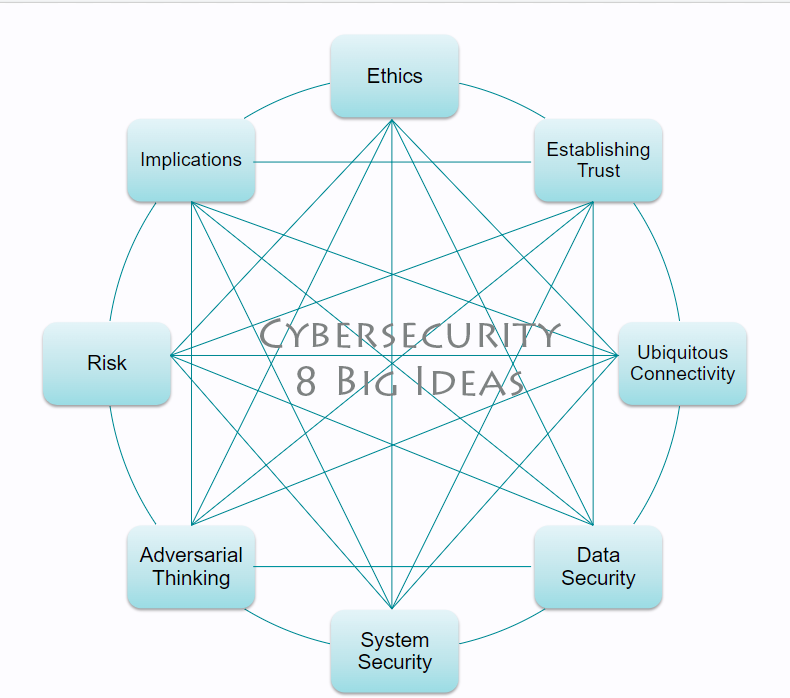
This is a year-long, introductory cybersecurity course. The overarching goal of the course is to introduce students to the foundational concepts, principles, and tools of cybersecurity. The course is centered on the Cybersecurity Curriculum Guidelinesand is thus situated in eight big ideas: ethics, establishing trust, ubiquitous connectivity, data security, system security, adversarial thinking, risk, and implications.
After this course, students will:
understand that cybersecurity has broad implications and ethical reflection and judgment are required.
understand the fundamental cybersecurity principles necessary to determine security requirements and mechanisms.
study historical events and their cybersecurity implications; relevant laws and policies governing data; and economic concerns and risk management trade-offs involved in making cybersecurity decisions from various stakeholder perspectives.
learn to challenge assumptions and practice thinking about opposing forces to analyze threats, vulnerabilities, and attacks.
evaluate the tools used to connect cyber-physical systems
practice using the encryption techniques needed to secure data across networks.
The Teach Cyber Curriculum has 8 modules. You can use all or some of the curriculum. Our curriculum was built to be modular.
Units
Estimated Number of Days
What is Cybersecurity
11
Risk, Adversity and Trust
17
The Elements of Cyberspace
20
Data, Software, Hardware, and Network Security
25
Countermeasures Against Cyberattacks
33
Security is Not Free
8
Threats, Vulnerabilities, and Attacks: A Closer Look
15
States, Stateless, Sovereignty and Cybersecurity
15
Labs
N/A
The Teach Cyber curriculum is modular so the units and lessons can be arranged and rearranged to fit the needs of your school and your students. Here are a few suggestions from the creators and users of Teach Cyber about how to sequence the units and lessons to make a course.
Semester Long Course with no Prerequisite Knowledge Using the US Cyber Range – 15 Weeks, ~65 contact hours
Course Outline
Teach Cyber Unit
Estimated Time
Part 1: Introduction to Cybersecurity
What is Cybersecurity Unit
~9 contact hours
Part 2: Technical Basics
The Elements of Cyberspace Unit
~15 contact hours
Part 3: Doing Cybersecurity
Data, Software, Hardware, and Network Security Unit
and
Countermeasures Against Cyberattacks
(note, these are long units, so you will have to select lessons from each)
~39 contact hours
Part 4: Tying it Together
Risk, Adversity and Trust – Lesson 6
~ 2 contact hours
Semester Long Course with no Prerequisite Knowledge Using the US Cyber Range – 15 Weeks, ~65 contact hours
Course Outline
Teach Cyber Unit
Estimated Time
Part 1: Introduction to Cybersecurity
What is Cybersecurity Unit
~9 contact hours
Part 2: Doing Cybersecurity
Data, Software, Hardware, and Network Security Unit
and
Countermeasures Against Cyberattacks
(note, these are long units, so you will have to select lessons from each)
~46 contact hours
Part 4: Tying it Together
Security is Not Free
States, Statelessness, Sovereignty and Cybersecurity – Lesson 2
Risk, Adversity and Trust – Lesson 6
~ 10 contact hours
Year Course without Cyber Range Access (50 min/day and 135 hours of instruction)
Supplement the course with activities (~50 hrs) from picoGym and picoCTF. PicoCTF includes challenges from six domains of cybersecurity including general skills, cryptography, web exploitation, forensics, reversing, binary exploitation (https://primer.picoctf.org/ ). CyberStart America is another source of activities.
Course Outline
Teach Cyber Unit
Estimated Time
Part 1: Introduction
What is Cybersecurity Unit
Risk, Adversity and Trust Unit (omit Credential Harvesting Lab)
States, Statelessness, Sovereignty and Cybersecurity Unit
~15 contact hours
[1] Teachers often ask us how which lessons to select in order to use Teach Cyber in a semester long course. Here is our #1 suggestion: when making selections, be sure to includes lessons from BOTH units because they work together. The Unit on Data, Software, Hardware and Network Security focuses how threats sources exploit vulnerabilities to create attacks. The Unit on Countermeasures Against Attacks focuses on preventing and detecting attacks. So if you are teacher looking to choose lessons, be sure to include lessons that teach students how to think about the cycle of threat sources use vulnerabilities to launch attacks, and cybersecurity professionals use countermeasures to try and prevent that from happening and to detect it when it is happening.
Cyber Discovery Kit
The Cyber Discovery Kit (CDK) is available for download as a pdf. In the CDK the 8 Big Ideas of Cybersecurity (Ethics, Trust, Ubiquitous Connectivity, Data Security, System Security, Adversarial Thinking, Risk, and Implications) are introduced. Students explore key principles and concepts and investigate cybersecurity vocabulary and careers. The purpose is to help students discover the vast field of cybersecurity.
The CDK is designed for 6th to 9th grade students in a club or classroom setting to heighten interest in your cybersecurity course, program, or pathway. Additionally, we hope that the experience allows students to reflect and make healthy, safe, and ethical decisions in cyberspace.
NCTA is a 12-credit hour graduate certificate for high school teachers. It includes coursework on teaching cybersecurity, foundations of cybersecurity, network security, and advanced topics. Four universities (DePaul University, University of Louisville, University of Arkansas-Little Rock, and California State University-Sacramento) will be offering the virtual program, with variation depending on the university’s program.
NCTA is supported by a grant from the NCAE-C , which is the National Centers of Academic Excellence in Cybersecurity (located within the National Security Agency).
Wyoming Teach Cyber Project
The WY Teach Cyber project will result in two online, asynchronous teacher professional development courses ( introductory and advanced 15-hour courses) to support Wyoming teachers in their journey toward teaching cybersecurity. Teachers will have the opportunity to take an end-of-course assessment and earn a WY Teach Cyber badge/certificate to indicate successful completion of each course.
The courses will meet the Quality Standards for Continuing and Professional Education and will be QM-certified, as well as being aligned to the Wyoming Computer Science Content and Performance Standards.
Cisco NetAcademy
Our partnership with Cisco NetAcademy provides free cybersecurity training for educators. Teachers self-enroll in courses and the training is self-paced. Badges are awarded upon completion.
If you are interested in the need for cybersecurity, privacy, and common attacks and protections start with the Cybersecurity Basics course. If you want to develop a broad foundational understanding, we recommend the Cybersecurity Essentials course. When you are ready to develop your understanding of networks, dive into the Networking Essentials course. The Packet Tracer course will introduce this network design, simulation, and modeling tool.